

BMI (Body Mass Index) is widely used as a tool to estimate whether a person’s weight is in a range of “better” or “worse.”
In this blog, we answer 5 common questions about BMI.
1. First, what is BMI?
BMI calculates your height and weight to get a rough estimate of whether you’re underweight, at a healthy weight, overweight, or in the obesity range.
The formula: Take your weight in pounds ÷ height in inches² × 703
Example
A person who weighs 150 lb and is 5 ft 5 in (65 inches):
BMI = (150 ÷ 65²) × 703 ≈ 25.0
As a result, this falls at the start of the overweight category
2. What are the standard BMI ranges for adults?
For most adults (age 20 and older), BMI falls into these categories:
- Underweight: less than 18.5
- Healthy weight:5–24.9
- Overweight:0–29.9
- Obesity:0 and above
3. How accurate is BMI?
In general, BMI is useful for population-level screening. It gives an overall idea of whether your weight may be a concern, but it doesn’t directly measure body fat or overall health. Therefore, for many, this is a helpful starting point, but it should not be used alone to assess health.
4. Why is BMI used?
So, why use BMI? BMI’s value comes from a number of factors, including:
- Quick and easy to calculate using only height and weight
- Standardized and widely accepted across health organizations
- Low-cost and accessible, requiring no special equipment
- Easy to track over a period of time, enabling monitoring of weight changes
- Effective for identifying potential health risks at a population level
- Supports clinical decision-making, often used alongside other measures to guide treatment or further evaluation
In addition, higher BMI is associated with increased risk of conditions like:
- Heart disease
- Type 2 diabetes
- High blood pressure
Organizations like the World Health Organization and CDC use BMI categories (underweight, normal, overweight, obese) to compare across populations and studies.
5. What are some limitations of BMI?
It’s important to understand that BMI has some limitations, such as:
- Doesn’t distinguish between muscle vs fat
- Muscular people (e.g., athletes) may have a high BMI but low body fat.
- Ignores fat distribution
- Abdominal fat (riskier) isn’t specifically measured.
- Doesn’t account for differences
- Age, sex, ethnicity, and body composition can affect what’s healthy.
- Is not a diagnostic tool
- Doctors use it as a starting point, often combined with:
- Waist circumference
- Blood pressure
- Blood tests
- Overall lifestyle factors
- Doctors use it as a starting point, often combined with:
There are several ways to assess weight as shown by this chart:
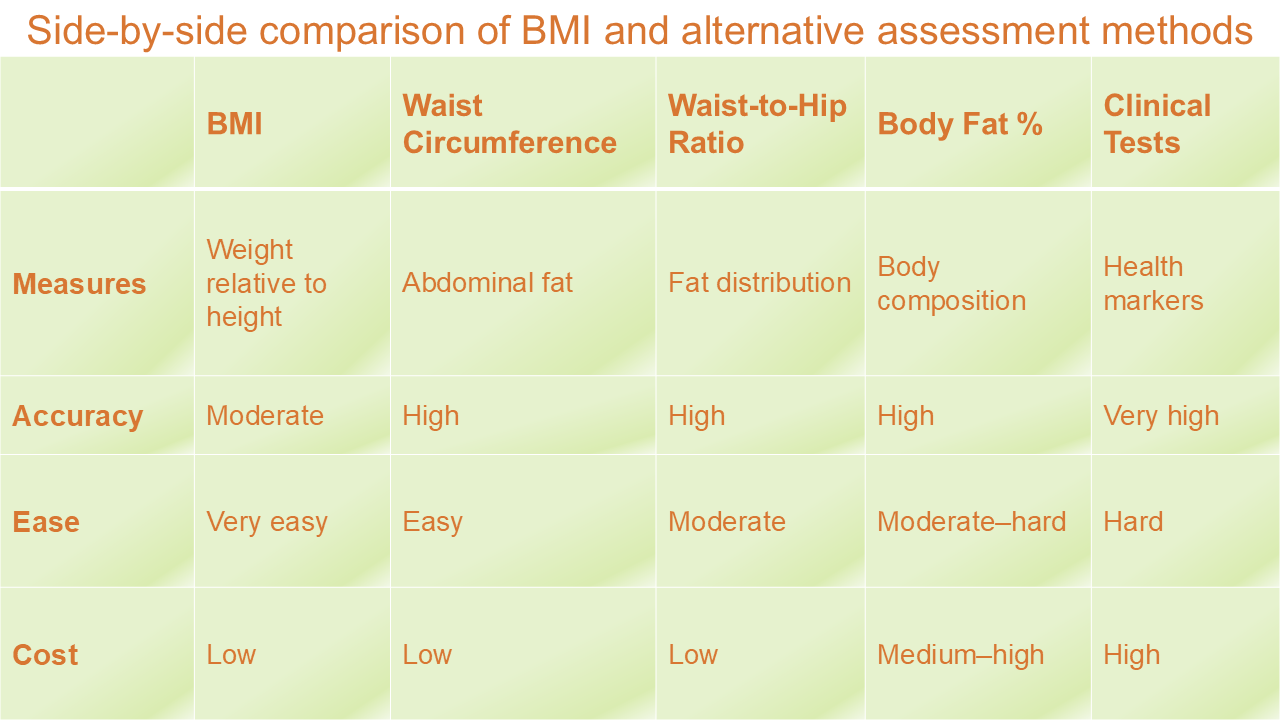
A healthcare professional can help interpret these factors together. So, if you’re thinking about your weight or health, consider using BMI as a starting point. After that, discuss your overall health with a qualified professional for guidance, like those at Vibrance by Hometown.
For example, at Vibrance, you’ll get comprehensive care to help with your weight loss journey, starting with how to interpret BMI or other measures and design a personalized program with a step-by-step program leading to a healthier you.